

The Angel Who Forgot Her Own Warning
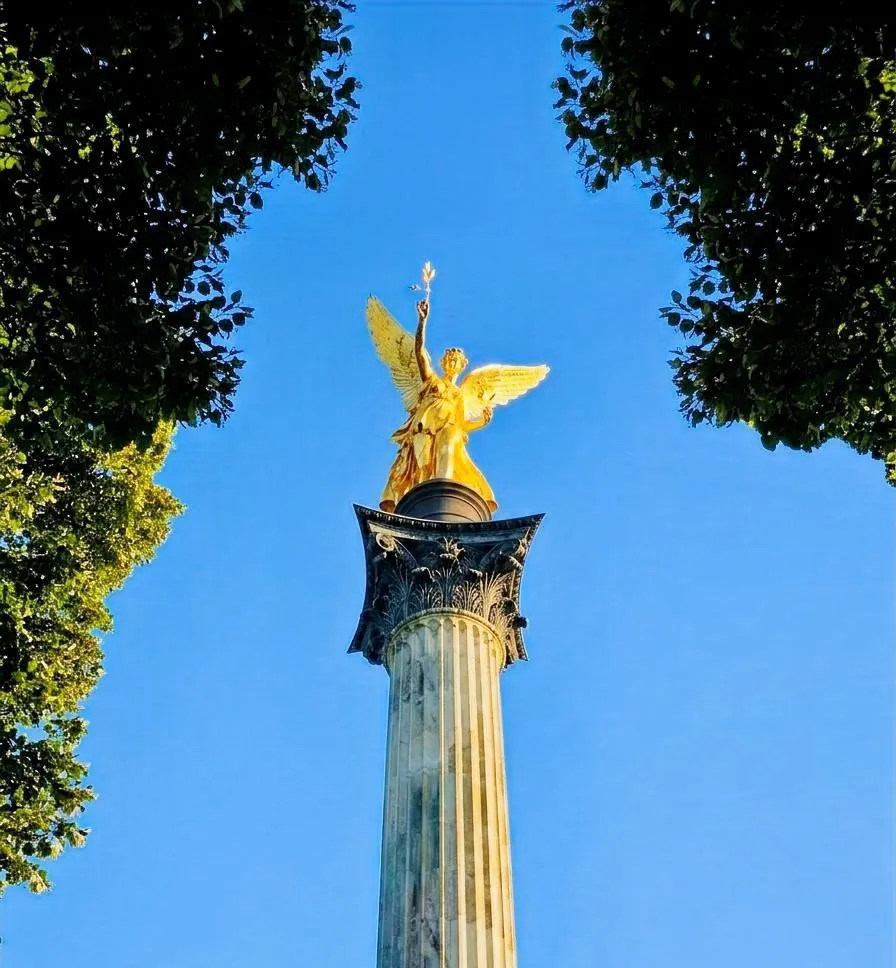
Photo by Adam Martin
The Angel Who Forgot Her Own Warning


Peace built as a victory trophy, forgotten as Germany re‑armed — the Friedensengel warns that calm isn’t permanent, and nations lose peace when they stop defending it.
Standing beneath Munich’s golden angel, and asking what “peace” actually cost?
On a rise above the Isar, in the Bogenhausen district, a gilded woman stands thirty-eight meters above the city on a Corinthian column. Although tourists photograph her at sunset and joggers pass beneath her without a glance, most people who climb the stairs up to the Prinzregent-Luitpold-Terrasse only know it a viewpoint. Almost nobody asks what she was actually built to say?
The Friedensengel, the Angel of Peace, the story of why she exists and what happened in the decades after she was made is one of the more uncomfortable lessons Munich has to offer.
A Monument to Twenty-Five Quiet Years
Although the foundation stone was laid on May 10 of 1896, the completed angel was fully unveiled on July 16 of 1899, 130 years ago today. She was not built to celebrate a war, but instead to celebrate the absence of one, specifically, twenty-five years without conflict following the Franco-Prussian War of 1870–71. This was the war that ended with German unification and the birth of the German Empire under Prussian leadership.
The small temple beneath the column carries four gold mosaics representing War, Victory, Peace, and a Cultural Blessing. They are in that order, as though peace were simply the reward that follows a victory. The cornerstones bear the faces of emperors and generals like Wilhelm I and Ludwig II - the men who built the new German state. The angel herself is not actually an angel but a replica of Nike, the Greek goddess of victory, holding an olive branch in one hand and a palm branch in the other. In this aspect Peace is not the opposite of conquest. It’s conquest’s dividend. This detail matters.
The Quarter-Century the Angel Actually Got
Bavaria prospered as it was folded into a new empire that was industrialising at an extraordinary speed. Germany’s population, cities, factories as well as self-image all grew at the same time. There was also the conviction, shared across the young empire’s elite, that unification had merely been the first act, and that Germany - having proven its strength on the battlefield - deserved a “place in the sun” to match Britain’s and France’s overseas empires.
Wilhelm II was crowned Emperor in 1888, only a few years before the angel’s foundation stone was laid. He pursued “Weltpolitik” - a naval buildup, colonial expansion and aggressive foreign policy built on the same martial confidence carved into the angel’s temple. The instrument built to commemorate peace was erected in the middle of a decade when the state it celebrated was actively arming itself for the next war. By 1914, less than fifteen years after the unveiling, that ambition had helped drag Europe into the First World War. This catastrophe was born from precisely the kind of triumphant nationalism the Friedensengel enshrined in gold.
Germany’s defeat in 1918 resulted in the punishing terms of the Treaty of Versailles, Hyperinflation, the Great Depression, and a wounded national pride hungry for someone to blame. These were the conditions in which the Weimar Republic – Germany in the 1920s - simply could not survive. Out of that wreckage, and out of Munich itself came the Nazi Party. The city that raised a monument to a peace built on martial pride, would within two generations, become the movement’s spiritual home, the “Hauptstadt der Bewegung”, or the Capital of the Movement.
None of this was inevitable in any single, straight line, as history rarely is. But the throughline is real. A peace that was really a pause between wars, built on unresolved ambition and imperial appetite, dressed in the language of harmony while quietly rehearsing for conquest and a society that mistook the absence of fighting for the presence of peace.
Why This Belongs in a Walking Tour
We don’t tell this story to depress people standing in a beautiful park at golden hour. We tell it because the angel is a perfect and physical example of something that is too easy to forget, that Peace is never a monument you build and then walk away from. Peace is not self-sustaining, but has to be actively defended, generation after generation, against the very human temptation to confuse strength with virtue and prosperity with entitlement.
The Friedensengel’s builders genuinely believed they were commemorating something permanent. They gilded her, gave her wings, put her on the highest column they could engineer, as if height and gold could make peace irreversible. Less than half a century later, this city stood at the centre of the deliberate murder of six million Jews and millions of others in the Holocaust and other Genocides committed by the Nazis. These atrocities began with the same unchecked nationalism the angel’s temple celebrates in gold and stone.
This is the warning that is worth carrying down from the terrace. Not that “peace is nice”, but something much harder, that the people who lose peace are almost never the people who realise that they are the ones actually losing it. They think that they are building something, and they believe that they are strong. The Friedensengel didn’t fail to prevent what came after because Munich didn’t value peace, it failed because peace was treated as a trophy for the past, not a discipline for the present. Every generation gets its quarter-century of relative calm and has to decide, in real time, whether it’s going to defend that calm or quietly spend it on pride, grievance, and the belief that history’s worst chapters belong to other people.
They don’t. They belong to whoever forgets to keep asking the question
*The Friedensengel stands in the Maximiliansanlagen park at the eastern end of Prinzregentenstraße, Bogenhausen — a five-minute detour from the Isar river path, and one of the more quietly important stops on a walk through Munich’s modern history. Photo © Adam.